Keeping the Lights On for Campus: Deep Q-Learning and MDPs for Micro-Energy Grid Optimization
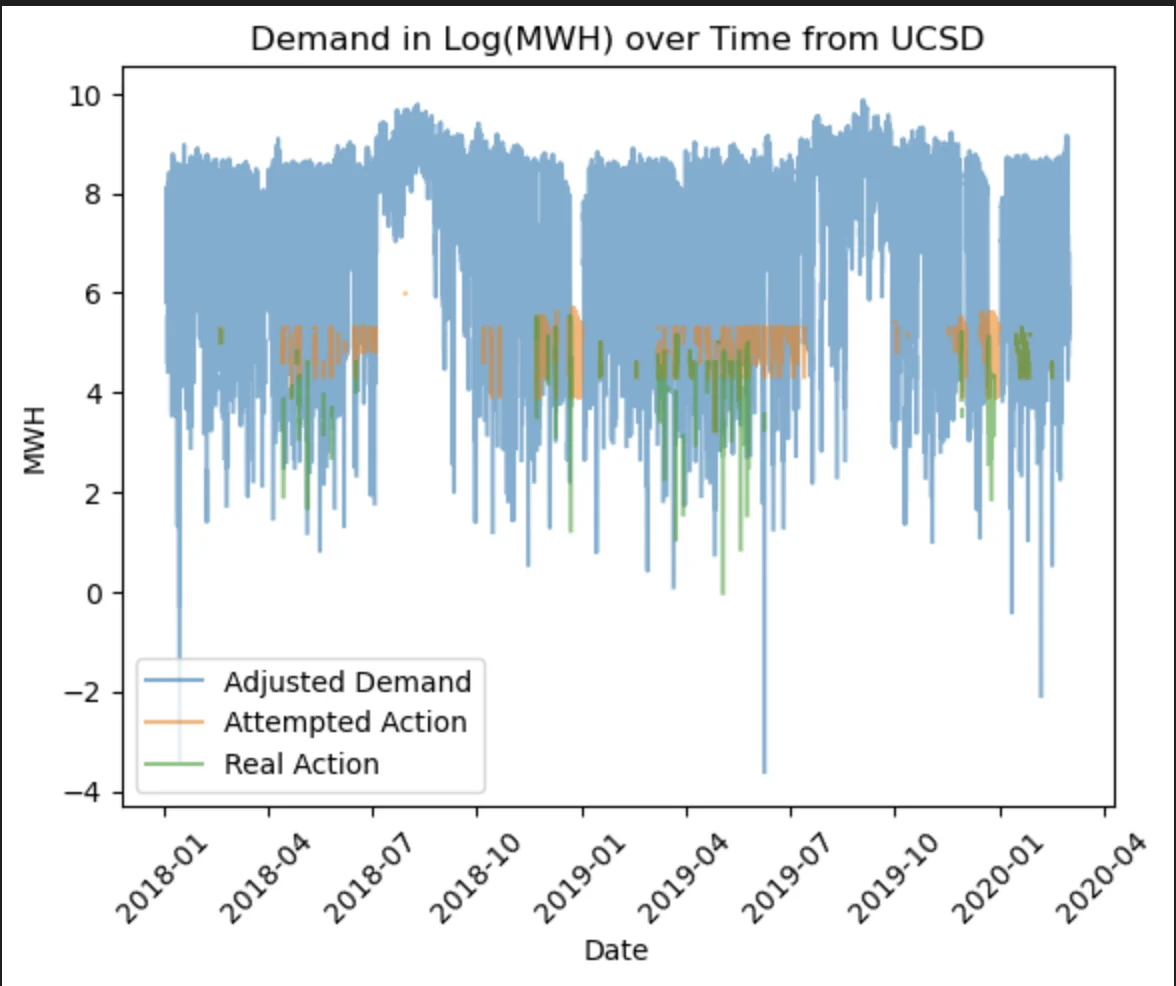
Frames a campus microgrid as a Markov decision process and learns when to store, use or buy energy. The deep Q-learning policy saves over $50,000 compared with a greedy one.
Abstract
Micro-grids such as college campuses with sustainable energy sources and non-renewable mixtures present an optimization opportunity for cost-saving, sustainability efforts and energy conservation.
By using the demand, generation, and storage data from these micro-grids we demonstrate that we can design a Markov-Decision-Process-based control system that can take real-time data for each grid and find the optimal allocation of resources to reduce non-renewable usage and buying energy from larger energy providers while also maximizing meeting demand constraints. We find that by using deep Q-learning with a discrete action space, our learned policy can save university campuses upwards of $50,000 over greedy policies.
Cite
@techreport{abukhadra2024keeping,
  title = {Keeping the Lights On for Campus: Deep Q-Learning and MDPs for Micro-Energy Grid Optimization},
  author = {Yasmina Abukhadra and Aakash Mishra},
  year = {2024},
  institution = {Stanford University}
}