Adaptive Controls for Hardware Fault-Correction in Embedded Systems
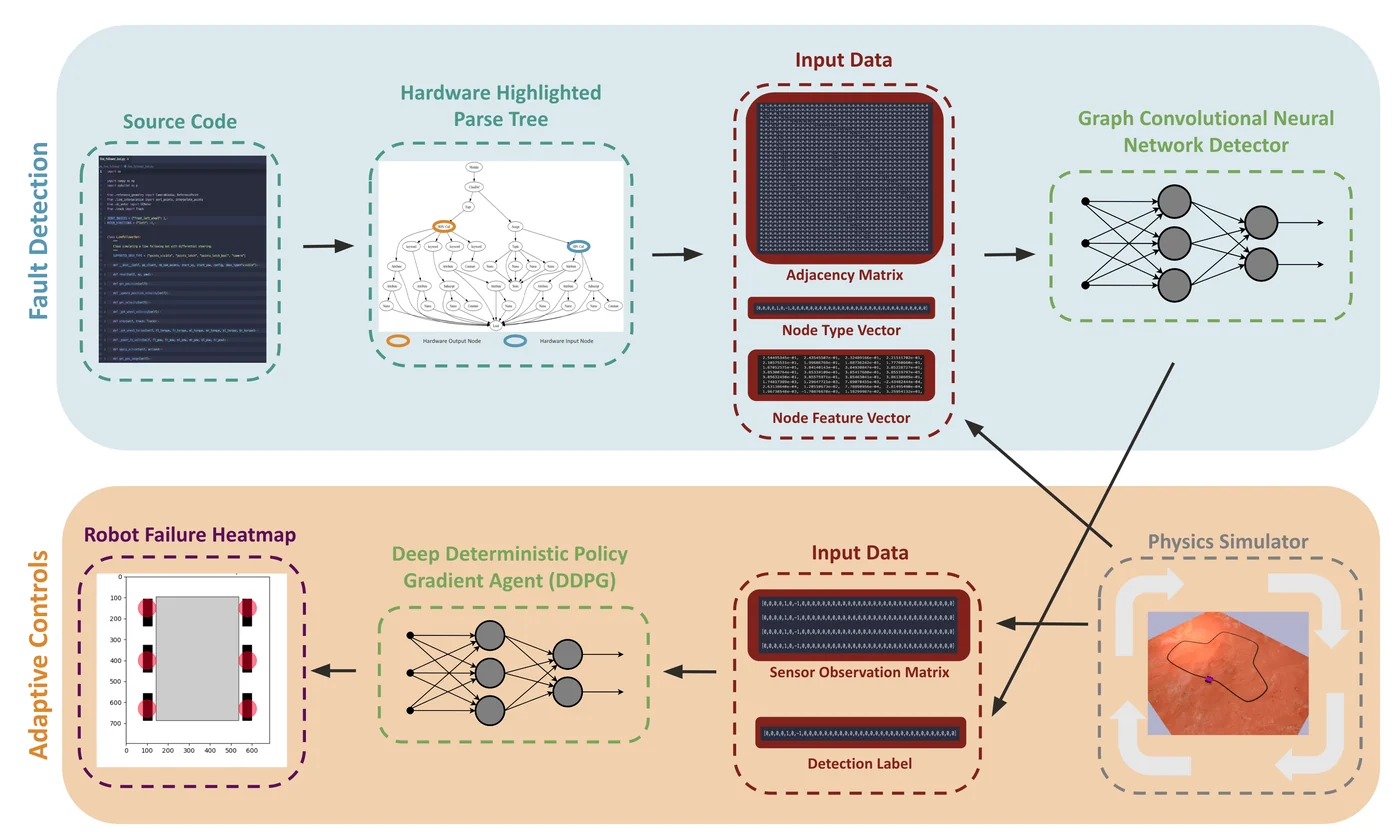
A robot that diagnoses and works around its own hardware faults. A graph network reads firmware to spot a failing motor, and an RL agent reroutes power to keep the robot on track.
Abstract
Embedded system fault detection is a multi-modal problem that can be difficult to solve, especially for real-time detection and correction on remotely deployed systems. Standard ways of assessing a bug on a deployed system are subject to temporal and physical constraints, and it can be hard to tell whether sensor input is reliable or whether a motor is behaving nominally.
We propose an autonomous method with three new pieces. First, a new intermediate representation for embedded firmware called a Hardware Highlight Parse Tree (HHPT). Second, a GNN-based detector that finds anomalous hardware behavior. Third, a reinforcement-learning system that adaptively controls its hardware in response to those anomalies, combined with the GNN detector. We show that it is possible to build a robust, adaptive system that can self-diagnose and correct hardware issues that would otherwise be hard to recover from.
Cite
@techreport{mishra2023adaptive,
  title = {Adaptive Controls for Hardware Fault-Correction in Embedded Systems},
  author = {Aakash Mishra and Dea Dressel},
  year = {2023},
  institution = {Stanford University}
}