Photometry of Active Centaurs: Colors of Dormant Active Centaur Nuclei
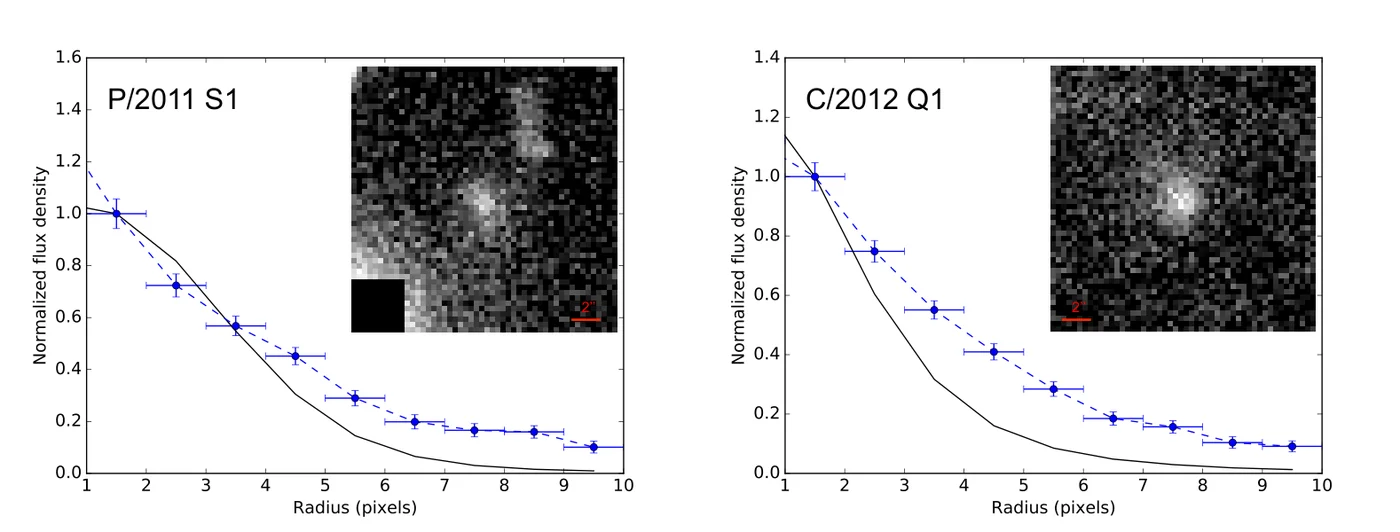
Multiband photometry of nine Centaurs, the small bodies between Jupiter and Neptune. Includes the first color measurements of two bare nuclei and mass-loss estimates for two active ones.
Abstract
We present multiband photometric observations of nine Centaurs. Five of the targets are known active Centaurs (167P/CINEOS, 174P/Echeclus, P/2008 CL94, P/2011 S1, and C/2012 Q1), and the other four are inactive Centaurs belonging to the redder of the two known color subpopulations (83982 Crantor, 121725 Aphidas, 250112 2002 KY14, and 281371 2008 FC76).
We measure the optical colors of eight targets and search for cometary activity. Three of the five active Centaurs showed no signs of activity at the time of observation, yielding the first published color measurements of the bare nuclei of 167P and P/2008 CL94 without possible coma contamination. Activity was detected on P/2011 S1 and C/2012 Q1, yielding relatively high estimated mass-loss rates of 140 ± 20 and 250 ± 40 kg/s, respectively.
We suggest that the relative paucity of red Centaurs with low-perihelion orbits may not be directly due to blanketing of the surface by unweathered particulates, but could instead be a result of higher levels of thermal processing on low-perihelion Centaurs in general.
Cite
@article{wong2019photometry,
  title = {Photometry of Active Centaurs: Colors of Dormant Active Centaur Nuclei},
  author = {Ian Wong and Aakash Mishra and Michael E. Brown},
  year = {2019},
  journal = {The Astronomical Journal},
  volume = {157},
  number = {6},
  pages = {225},
  doi = {10.3847/1538-3881/ab1b22}
}